Chess Engines Do Weird Stuff
Things LLM people can learn from
Training method
Since AlphaZero, lc0-style chess engines have been trained with RL. Specifically, you have the engine (search + model) play itself a bunch of times, and train the model to predict the outcome of the game.
It turns out this isn't necessary. Good model vs bad model is ~200 elo, but search is ~1200 elo, so even a bad model + search is essentially an oracle to a good model without, and you can distill from bad model + search → good model.
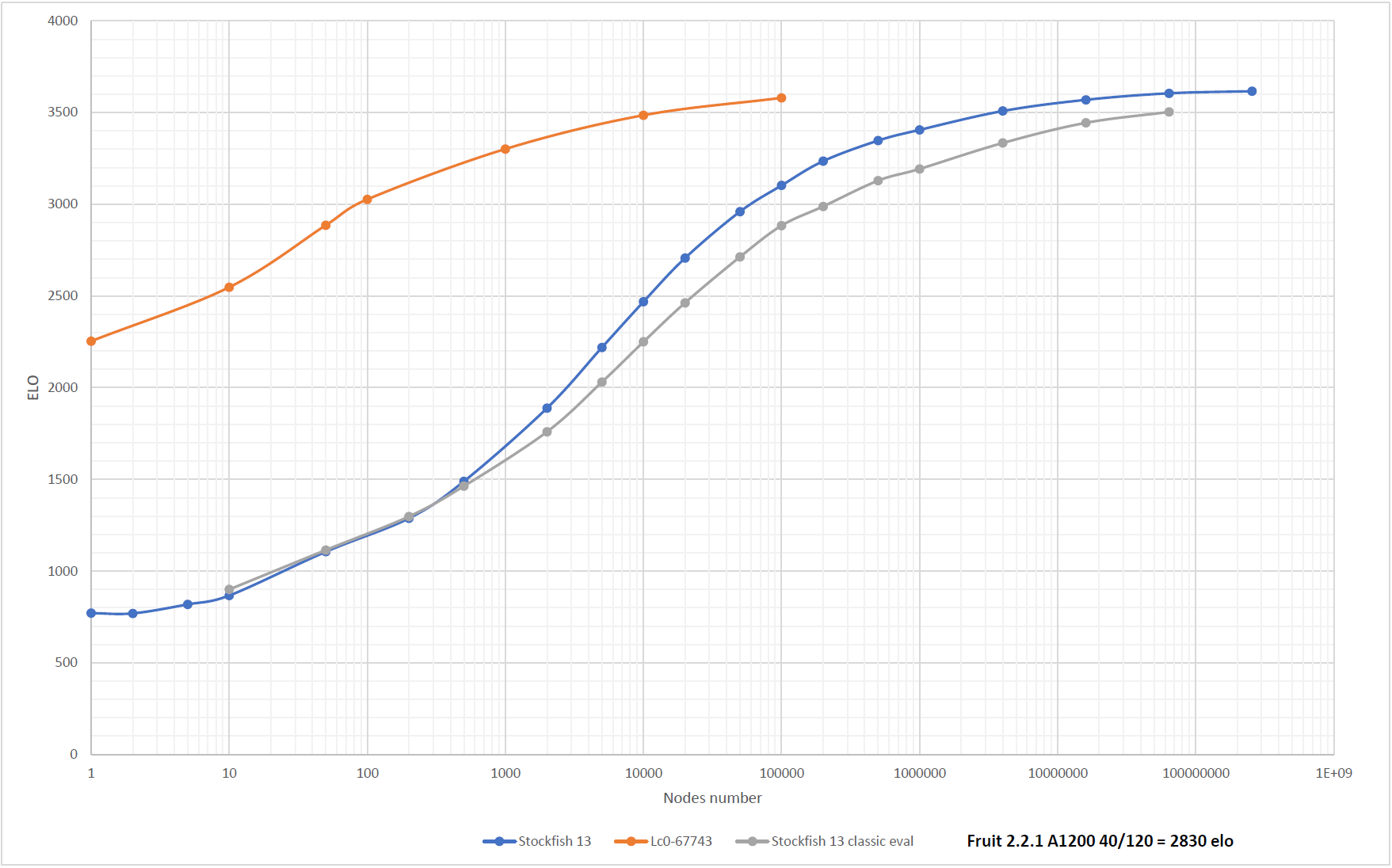
So RL was necessary in some sense only one time. Once a good model with search was trained, every future engine (including their competitors!)1 can distill from that, and doesn't have to generate games (expensive). lc0 trained their premier model, BT4, with distillation and it got worse when you put it in the RL loop.
What makes distillation from search so powerful? People often compare this to distilling from best-of-n in RL, which I think is limited — a chess engine that runs the model on 50 positions is roughly equivalent to a model 30x larger, whereas LLM best-of-50 is generously worth a model 2x larger. Perhaps this was why people wanted test-time search to work so badly when RLVR was right under their noses.
Training at runtime
A recent technique is applying the distillation trick at runtime. At runtime, you evaluate early positions with your NN, then search them and get a more accurate picture. If your network says the position is +0.15 pawns better than search says, subtract 0.15 pawns from future evaluations. Your network live adapts to the position it's in!
Training on winning
The fundamental training objective of distilling from search is almost but not quite what we actually care about: winning. It's very correlated, but we don't actually care about how well the model estimates one position, we care about how well it performs after search, after looking at 100 positions.
To fix this, lc0 uses a weird technique called SPSA: you randomly perturb the weights in two directions, play a bunch of games, and go the direction that wins more.2 This works very well and can get +50 elo on small models.3
Consider for a moment how insane it is that this works at all. You're modifying the weights in purely random directions. You have no gradient whatsoever. And yet it works quite well! +50 elo is ~1.5x model size or ~a year's worth of development effort!
The main issue with this is that it's wildly expensive. To do a single step you must play thousands of games with dozens of moves and hundreds of position inferences per move.
Like LLMs, you train for a long time on a pseudo-objective that's close to what you want, then a short time on a very expensive and limited objective that's closer to what you want.
Tuning through C++
The underlying technique of SPSA can be applied to literally any number in your chess program. Modify the number, see if it wins more or loses more, move in the direction that wins more. You have a hand-tuned heuristic that if there's a checkmate in the search from a position you should back off by depth 1? Replace that with thousandths-of-a-depth and then tune it with SPSA — turns out the optimal value is actually to back off by depth 1.09, which nets you 5 elo. You can do this for every number in your search algorithm. You can do something that looks a lot like gradient descent through arbitrary C++ because you have a grading function (winning).
Weird architecture
lc0 uses a standard-ish transformer architecture, which they found to be hundreds of elo better than their old convolution-based models. It's still confusing to me that the transformer biases apply to literally every application imaginable. The only substantial architectural change they use is "smolgen", a system for generating attention biases. They claim smolgen is a ~1.2x throughput hit but an accuracy win equivalent to 2.5x model size. Why is it so good? I find all the explanations poor.
Notes
weight += direction and one where weight -= direction. Then you play these two versions against each other. If positive wins, you do weight += direction * lr. If negative wins, you do weight -= direction * lr.
↩